Quick answer: Your Sun sign describes the zodiac position of the Sun at birth; your Moon sign is where the Moon was; and your Rising sign (Ascendant) is the zodiac sign rising on the eastern horizon. In Western astrology they are popularly called the Big Three and interpreted through different themes. Your Rising sign needs a reliable birth time.
Find your Big Three: Calculate all three together, or explore your Moon sign, Rising sign, or complete birth chart with AstroLaab’s free calculators.
If your Sun sign has never sounded entirely like you, a birth chart may give you more vocabulary to explore. This guide explains the differences without pretending that astrology can diagnose your personality or predict what will happen in your life.
Three chart positions. Three symbolic lenses.
What are the Sun, Moon and Rising signs?
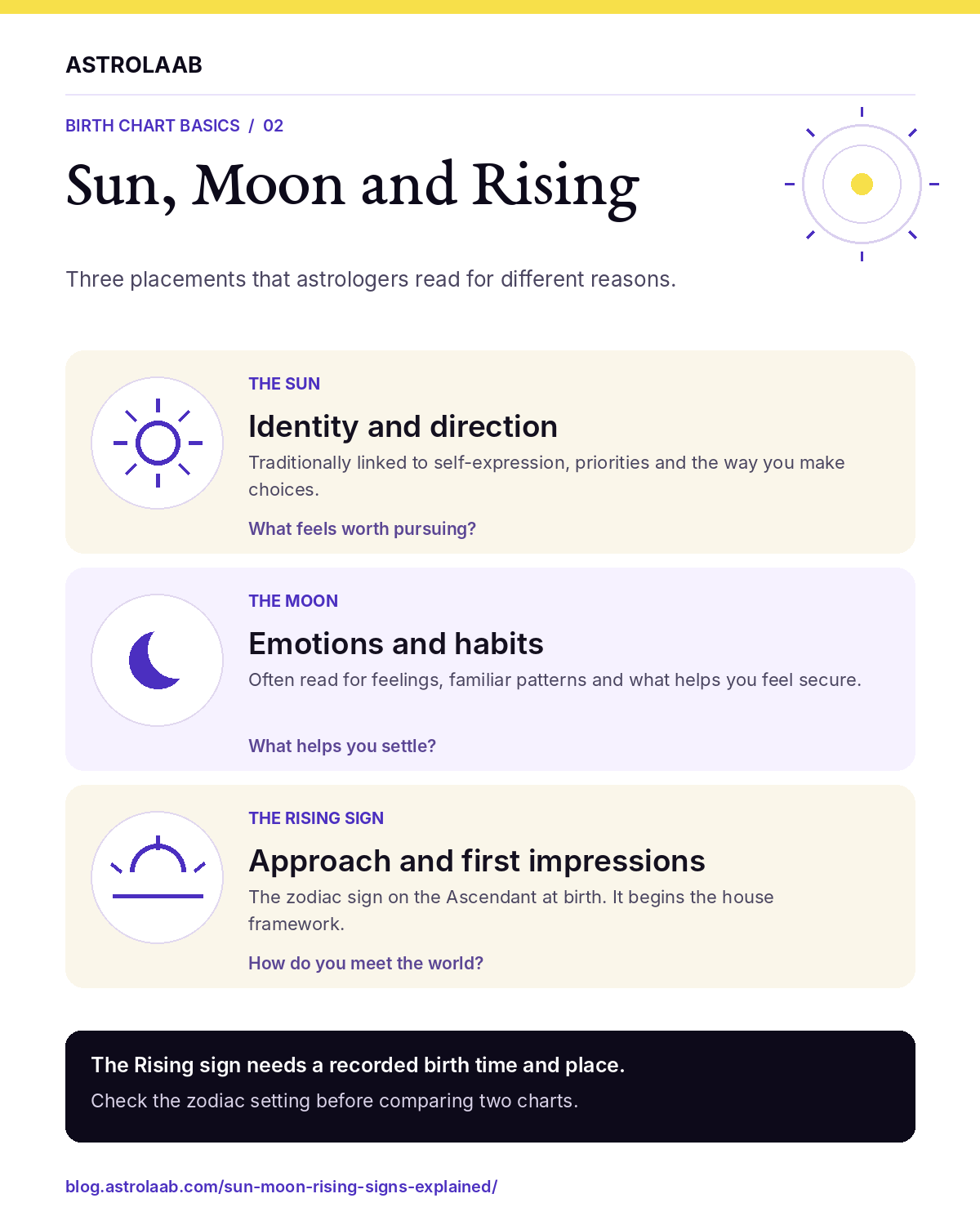
In modern Western astrology, the Big Three refers to your Sun sign, Moon sign and Rising sign (Ascendant). They are three different coordinates or labels within a natal chart, not three scientific measurements of who someone is. Each represents a different set of symbolic themes in astrological interpretation.
Your Sun and Moon signs are taken from the positions of those two bodies along the zodiac at birth. Your Rising sign is calculated from which zodiac degree was on the eastern horizon at that time and location. It is therefore not a third planet.
The three may all fall in different signs, or two or even all three may share a sign. None is inherently ‘better’. In astrology they are intended to be interpreted together, alongside the rest of the chart.
Sun sign meaning: identity and expression
In astrological tradition: The Sun is associated with vitality, conscious direction, visibility, creative expression and what a person seeks to become. This is why popular Sun-sign horoscopes center the Sun sign, although a whole chart contains far more information.
Examples of symbolic language: an Aries Sun is often associated with taking initiative, while a Taurus Sun is conventionally linked with steadiness and persistence. Compare our Aries and Taurus guides. These are traditions of description, not reliable personality tests.
How to find it: In a birth-chart calculator look for the solar glyph ☉ or the entry labeled Sun. Check the zodiac system before assuming the sign. A Western tropical Sun sign and a sidereal Sun sign can differ for the same birth.
Moon sign meaning: emotional patterns
In astrological tradition: The Moon is linked with responses, comfort, habits, memory, domestic life and emotional needs. Some astrologers describe it as one’s ‘inner world’, though the imagery should not be taken as a verified theory of psychology.
The Moon moves across the zodiac much faster than the Sun, changing sign roughly every two to two-and-a-half days. That means people born on the same date can have different Moon signs, especially near a changeover. Time zone and birth time may matter.
A Cancer Moon is traditionally discussed through themes of care and belonging; a Gemini Moon through curiosity and language. These comparisons describe symbolic associations, not fixed behavior. Browse the Cancer and Gemini field guides for those sign vocabularies.
How to find it: Look for the Moon glyph ☽ in the chart legend, and read its sign and degree. Don’t infer your Moon sign from your usual Sun-sign date range.
Rising sign meaning: the Ascendant and horizon
Your Rising sign is the zodiac sign containing the Ascendant: the point where the ecliptic meets the eastern horizon at the birth location and moment. Because Earth rotates, the sign on this horizon changes through the day, often roughly every couple of hours—but the exact timing varies substantially by season and latitude.
In Western symbolism, the Ascendant is often discussed as presentation, approach, beginnings and the way an individual meets new situations. It is sometimes called a ‘mask’, but that phrase can be misleading: astrologers generally mean an organizing angle, not that every person is hiding their true self.
The Ascendant is also important because the first house is related to it in many house systems. A changing birth time can alter the rising degree and house structure; some very high-latitude chart calculations require additional care.
How to find it: In a natal chart, look for ‘ASC’, ‘AC’ or ‘Ascendant’. It requires a dependable birth time and location. A chart produced with a default noon birth time cannot reliably tell you your Rising sign.
Sun vs Moon vs Rising: a practical comparison
- Sun: Where the Sun was in the chosen zodiac; frequently interpreted as conscious identity and direction.
- Moon: Where the Moon was; frequently interpreted as emotional rhythms, comfort and habits.
- Rising: Which zodiac degree rose on the eastern horizon; frequently interpreted as approach to life and the starting point of house interpretation.
- All three: Can be in different signs, and their meanings should not be reduced to a deterministic type or diagnosis.
Try reading the same sign with different placements: an Aquarius Sun and an Aquarius Moon are not treated identically by many astrologers, because the solar and lunar symbols differ. A Leo Ascendant is not automatically a Leo Sun. Our Aquarius and Leo guides describe those sign-level themes.
How to find your Big Three step by step
- Find your birth date and birthplace, ideally with a recorded birth time.
- Use a reputable chart calculator and confirm time-zone and daylight-saving details.
- For a common Western reading, select the tropical zodiac. Record the chosen house system too.
- Find the Sun ☉, Moon ☽ and Ascendant ASC in the chart legend.
- Write down each sign and degree separately, and double-check a borderline result.
- If you don’t know your birth time, label the rising sign uncertain rather than guessing.
A chart is a calculated diagram, so the inputs matter. If two sites disagree, compare their settings before assuming one is wrong. For the full reading process, see What Is a Birth Chart?.
How the Big Three work together: an illustrative example
Imagine an entirely hypothetical chart with a Virgo Sun, Pisces Moon and Sagittarius Rising. A modern Western astrologer might contrast Virgo’s attention to detail with Pisces’ imaginative or sensitive symbolism, while interpreting Sagittarius at the horizon as an exploratory outward style.
This example is deliberately fictional; it describes how a practitioner might combine symbols, not evidence of someone’s inner character. No particular set of placements tells you what a stranger is truly feeling, how ethical they are or whether a relationship will succeed.
Notice why the whole-chart viewpoint matters: an astrologer might then consider house placements and aspects rather than declaring that one sign cancels out the others. Read the 12 houses explained for the next layer.
Western and Vedic Big Three: important differences
Popular Western Big Three content usually assumes a tropical zodiac, while many Vedic or Jyotisha charts use a sidereal zodiac. The same calculated Sun, Moon and Ascendant can therefore receive different sign labels. Some Jyotisha approaches give particular attention to the Moon’s rashi, nakshatra and the Ascendant or lagna.
The phrase ‘Big Three’ is not a complete translation of Jyotisha interpretation: Vedic frameworks use additional concepts such as grahas, bhavas, nakshatras, dashas and divisional charts. See our Western vs Vedic comparison and tropical vs sidereal guide for clarity.
Common myths about the Big Three
- ‘My Rising sign is my fake personality.’ No: that is an oversimplified metaphor, not a universally accepted astrological rule.
- ‘My Sun sign decides my compatibility.’ No scientific evidence supports such predictions, and astrologers themselves frequently compare more than the Suns.
- ‘Moon signs never need an exact birth time.’ The Moon changes sign; timing matters near transitions.
- ‘Everyone has three different signs.’ They can be the same or overlap.
- ‘The tropical and sidereal placements should match.’ Their reference systems differ, so they need not.
Sun, Moon and Rising FAQs
Can I know my Rising sign without a birth time?
Not with dependable precision. The Ascendant depends on the local horizon at the moment of birth.
Which Big Three sign is most important?
There is no single scientific ranking. Traditions and astrologers assign different roles to each; learn what each point represents before comparing.
Is a Moon sign more accurate than a Sun sign?
Neither can be validated as a personality diagnostic. They are different symbolic placements.
Why did my Rising sign change on another website?
Check the birth time and location, daylight-saving rules, tropical/sidereal setting and chart calculation details.
Is my star sign the same as my Sun sign?
Usually, yes. In everyday US and UK horoscope language, star sign and zodiac sign generally refer to the Sun sign assigned from a birthday. Your Moon and Rising signs are separate chart placements, so they may be different. To calculate all three, use the Big Three Calculator.
Is my Rising sign the same as my Sun sign?
Not necessarily. The Sun sign is based on the Sun’s zodiac longitude; the Rising sign is the zodiac sign on the eastern horizon at your birth moment and location. They can be the same by coincidence, but one does not determine the other. The Ascendant Calculator requires a reliable birth time to determine it.
Sources and editorial note
Astrodienst Astrowiki: Sun — role of the Sun alongside Moon and Ascendant in astrology.
Astrodienst Astrowiki: Ascendant — the rising point and connection to the horizon.
Astrodienst Astrowiki: Birth Chart — chart input requirements.
Editorial note: Planet positions and the horizon are calculable; personality traits and emotional meanings attributed to zodiac signs are not established by scientific evidence. Our Editorial Policy.
Leave a Reply