When two birth charts disagree, don’t guess. Diagnose.
A field guide to checking recorded birth details, historical time-zone rules, zodiac settings, house divisions and the way a chart is read. Includes a reproducibility worksheet you can reuse across chart websites.
If one website says your Moon is in one sign and another places it elsewhere—or your planets move to different houses—the first question is not “Which reading should I believe?” It is “Did these two programs calculate the same thing from the same inputs?”
AstroLaab’s birth chart beginner’s guide explains the parts of a natal chart. This companion resource has a different job: it is a checkable troubleshooting protocol for comparing calculations, followed by a careful way to interpret a verified result. It is useful for students, educators and anyone comparing more than one chart website.
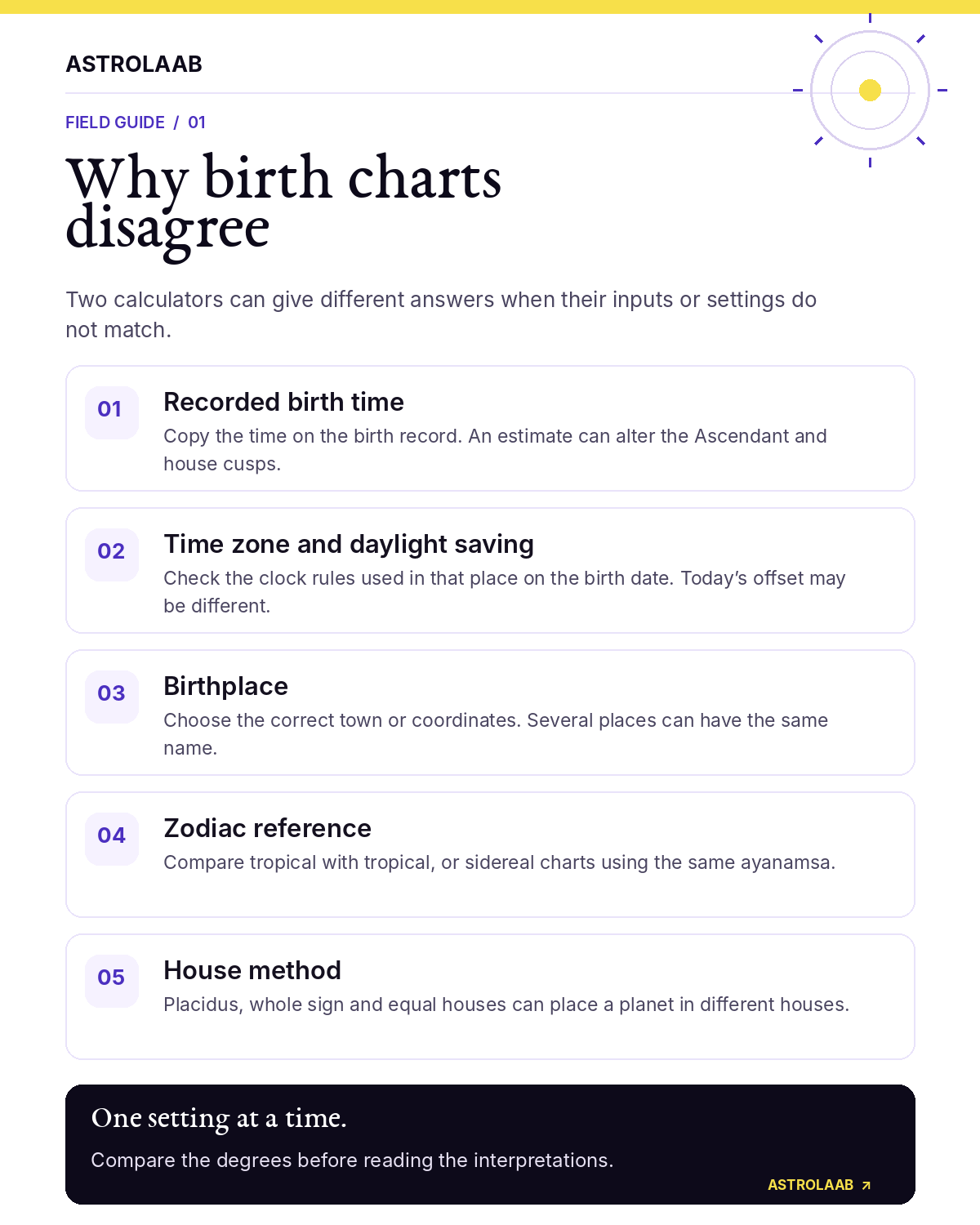
1. What does “birth chart accuracy” mean?
There are three different questions that people often combine into one:
Is the date, recorded local birth time and selected birthplace faithful to the available birth record?
Given the same instant, coordinates and settings, do the programs return the same ecliptic positions, angles and house cusps?
Are both charts showing the same zodiac, house system, objects, rounding rules and aspect orbs?
What symbolic meanings does an astrological tradition assign to those positions? That is a different question from computational reproducibility.
A technically reproducible chart is not scientific proof of a personality interpretation or a prediction. It means the chart’s astronomical inputs and stated conventions can be checked. That narrower definition is what this guide uses.
2. Find the pattern: what exactly disagrees?
Before changing settings, identify the first difference you can actually observe. Comparing sign labels alone is less informative than comparing the degrees shown beside the labels.
| What is different? | First likely check | What to compare next |
|---|---|---|
| Many planets have different sign labels. | Tropical versus sidereal zodiac; sidereal ayanamsa if applicable | Compare longitudes and the selected zodiac before correcting the birth time. |
| Moon sign is different but most slow-moving planets agree. | Birth time, date and time-zone conversion, especially near a Moon-sign boundary | Compare the Moon’s exact longitude and whether either chart used a default time. |
| Rising sign, angles or houses differ. | Exact birth time, local-time conversion, birthplace and zodiac choice | Check Ascendant degree first, then the house system. The Ascendant itself is not changed merely by switching between standard house systems while other settings stay fixed. |
| Planet degrees agree but house numbers differ. | Placidus versus whole sign versus equal houses | Check the house-system setting and relevant house cusps. |
| Signs, degrees and houses agree; aspect lines differ. | Aspect selection and allowable orb | Compare the aspect angle, actual angular separation and orb threshold. |
| One wheel shows extra glyphs or a different orientation. | Display settings and included chart objects | Check lunar nodes, asteroids, minor points, chart orientation and glyph legend. |
3. The AstroLaab five-check protocol
- Freeze the birth record. Copy the date exactly as recorded (including day/month/year order), the local clock time with AM/PM, and the specific birthplace. Do not quietly replace an uncertain time with noon or 6 a.m.
- Normalize the instant. Determine which time-zone and daylight-saving rules were in force at that place and on that historical date, then record the corresponding UTC instant. IANA maintains a time-zone database with historical local-time rules; older records may still require special research.
- Match coordinate conventions. Check tropical versus sidereal; if sidereal, write down the named ayanamsa. Comparing a tropical chart and a sidereal chart without this label is not an equal-settings comparison.
- Match the chart method. Record house system (such as Placidus, whole sign or equal) and whether calculations use the same geocentric/topocentric or other specialized options where relevant. Compare degrees before reading house labels or aspects.
- Compare a small set of outputs. Start with the exact Sun and Moon longitudes, Ascendant degree, Midheaven (MC), two house cusps, and one aspect orb. Make one adjustment at a time until you can explain the remaining difference.
If the birth record lacks a trustworthy time, your Sun and many slower planetary sign positions may still be useful as time-uncertain calculations, but houses and the Ascendant generally cannot be presented as verified. The Moon can also change zodiac signs within a day.
4. Worked example: a one-hour error with no change in birthday
This is a fictional input-audit example, not a calculated natal chart. It demonstrates how a simple clock-setting difference can cascade into a different chart.
| Recorded input | Program A | Program B |
|---|---|---|
| Date and place | 15 July 2000 · London, UK | 15 July 2000 · London, UK |
| Recorded birth time | 9:15 a.m. local | 9:15 a.m. local |
| Interpretation of local time | British Summer Time, UTC+01:00 | Incorrectly treated as GMT, UTC+00:00 |
| Resulting UTC instant | 08:15 UTC | 09:15 UTC |
| Difference | Recorded time converted with the seasonal offset | Birth instant shifted by one hour |
The two programs were given what looked like the same local clock time, but not the same astronomical instant. That one-hour difference can affect the chart angles and house positions and changes the Moon’s precise position slightly. It does not establish that a particular Rising sign or house placement changed in this fictional case; you would need to calculate the full chart to know.
Why this example matters: on some historical daylight-saving transition dates, a local clock time may even be ambiguous or nonexistent. Do not force an automated answer when the record itself needs investigation. For local-time rules, consult the IANA Time Zone Database and primary regional records where needed.
5. Two settings that beginners often confuse
Tropical and sidereal zodiacs change the sign reference
The tropical zodiac anchors its starting point to the March equinox; sidereal zodiac approaches anchor a starting point relative to a chosen stellar reference. A sidereal calculation also needs an ayanamsa convention. The same astronomical birth instant can therefore receive different zodiac degrees and sign labels. Read our tropical versus sidereal guide before treating a sign discrepancy as a software fault.
House systems change the division of a chart
Whole sign assigns the Ascendant’s entire sign as the first house. Equal uses 30-degree houses starting at the Ascendant degree. Placidus is a quadrant method with differently calculated intermediate cusps. When the birth instant, location and zodiac are held constant, changing the house system can reassign a planet to a different house without changing that planet’s zodiac longitude. It does not by itself change the Ascendant’s astronomical degree.
This distinction is crucial: if a person reports that “my Sun moved from house 8 to house 9,” first check house systems; if “my Sun moved from Leo to Cancer,” check the zodiac reference or the input moment. Our 12 houses guide explains the vocabulary used in both cases.
6. Interpret a checked chart without skipping steps
Once the calculated positions are consistent, read the chart from the simplest components outward. A long paragraph of interpretation is less helpful if it never names the positions behind its claims.
- Planet or point: What is being described? For example, the Moon is conventionally discussed in relation to emotional and habitual themes; the Ascendant is a chart angle.
- Zodiac sign: What symbolic style does the selected astrological tradition attach to the placement? Note whether the chart uses tropical or sidereal labels.
- House: In which life-area framework is the placement being read? Only rely on houses when the birth time and house choice are documented.
- Aspects: Which angular relationships are actually present? Check the degrees and the orb rather than treating decorative lines as an explanation.
- Whole-chart context: Are multiple themes repeated or in tension? Ask reflective questions instead of presenting one placement as a deterministic verdict.
For a starting point based on recorded birth data, try the free Western Birth Chart Calculator or the more focused Sun, Moon and Rising Calculator.
7. Birth chart accuracy checklist: copy, print, reuse
This is the part to save when you compare two websites, teach a class or report a suspected calculation problem. Record the values before switching a setting.
Download the one-page checklist (PDF) ↗
- Birth date and date format confirmed from the original record.
- Local clock time copied with AM/PM or 24-hour format; uncertainty recorded.
- Birthplace selected by actual location, not just a matching city name.
- Historical time zone and daylight-saving status checked.
- Converted UTC instant recorded (or marked uncertain).
- Zodiac reference labelled tropical or sidereal; ayanamsa specified when relevant.
- House system named: Placidus / whole sign / equal / other.
- Other options noted when applicable: apparent/true, geocentric/topocentric, node type.
- Exact Sun, Moon and Ascendant degrees compared before sign and house labels.
- Any remaining disagreement described precisely; only one setting changed per test.
8. Frequently asked questions
Is there one “most accurate” birth chart website?
There is no universal answer independent of data and settings. A reliable chart source should disclose what it calculates, handle the stated birth instant and location correctly, and allow you to understand its conventions. That is different from validating an interpretive claim.
Can my Moon or Rising sign change when I correct the birth time?
It can, depending on the original error and how close the calculated point is to a sign boundary. Ascendant calculations are especially sensitive to time and place; the Moon moves noticeably over a day. Do not assume a sign change without comparing the actual degrees.
Can Placidus and whole-sign houses produce different planet houses?
Yes. They partition the chart differently. With all other settings held constant, that house difference does not imply that the underlying planet moved in the sky.
Why does one chart show more aspect lines?
The programs may use different allowable orbs, include different aspect types or draw aspects to different points. Ask which two positions form the aspect, its exact angle and its allowed orb.
What if I don’t know my birth time?
Don’t invent one and label the output exact. You can still examine placements whose signs are stable throughout the possible time window, but Rising sign, houses and other time-sensitive details should remain explicitly uncertain.
Can this checklist verify a Vedic kundali?
It can help verify the shared basics—birth instant, locality, time-zone assumptions—and clarify which zodiac is in use. A comprehensive Jyotisha audit additionally needs the relevant ayanamsa, house/bhava conventions and other tradition-specific methods. AstroLaab’s own calculator is Western tropical, not a Vedic kundali generator.
Use a known birth date, time and birthplace, then follow the worksheet above to document your results.
9. Methodology, sources and attribution
Prepared by AstroLaab Editorial Team · First published 9 November 2026. This guide is an original educational troubleshooting framework. It uses a fictional time-zone case, not a claim that two particular commercial calculators were independently audited. The steps are designed to isolate differences in chart inputs and conventions.
- Astrodienst — Why Does My Chart Look Different? Discusses technique, place and time-zone differences when comparing charts.
- IANA — Time Zone Database. Reference for historical local clock rules and UTC-offset changes.
- United States Naval Observatory — Daylight Saving Time. General explanation of seasonal clock changes.
- Astrodienst — Swiss Ephemeris Programming Documentation. Documentation of time conversion, planetary calculations and house options.
- Astrodienst — Astronomical Foundations of Astrological Houses. Reference for house geometry, angles and alternative systems.
Leave a Reply