
Quick answer: The 12 houses in astrology are divisions of a birth chart traditionally associated with life areas such as self-expression, resources, communication, home, partnerships and public roles. Houses are not the same as zodiac signs: their boundaries depend on birth time, location and house calculation method. The interpretations are symbolic, not scientifically reliable forecasts.
If the wheel inside a natal chart feels crowded, think of its twelve houses as numbered chapters. They tell an astrologer where to read a planet’s symbolism, while planets and zodiac signs add other layers. Below is a reference guide to each house, plus the differences between common Western and Vedic approaches.
Twelve areas of life within an astrological chart.
What are the 12 houses in astrology?
Astrological houses are twelve divisions used to organize a chart around a location and time. Zodiac signs are divisions of a zodiac coordinate circle, while houses refer to the observer’s relationship to the local sky. In traditional readings, the houses describe areas of life in which planets and signs are interpreted.
The simplest learning model is: planet = symbolic function; sign = style of interpretation; house = life context. That metaphor helps you understand the vocabulary, but it is not a scientifically validated model of personality or experience.
The number and exact boundaries of the houses depend on the selected house system. Different approaches include whole sign, equal house, Placidus, Porphyry and others. Not every system places the angles exactly on house cusps.
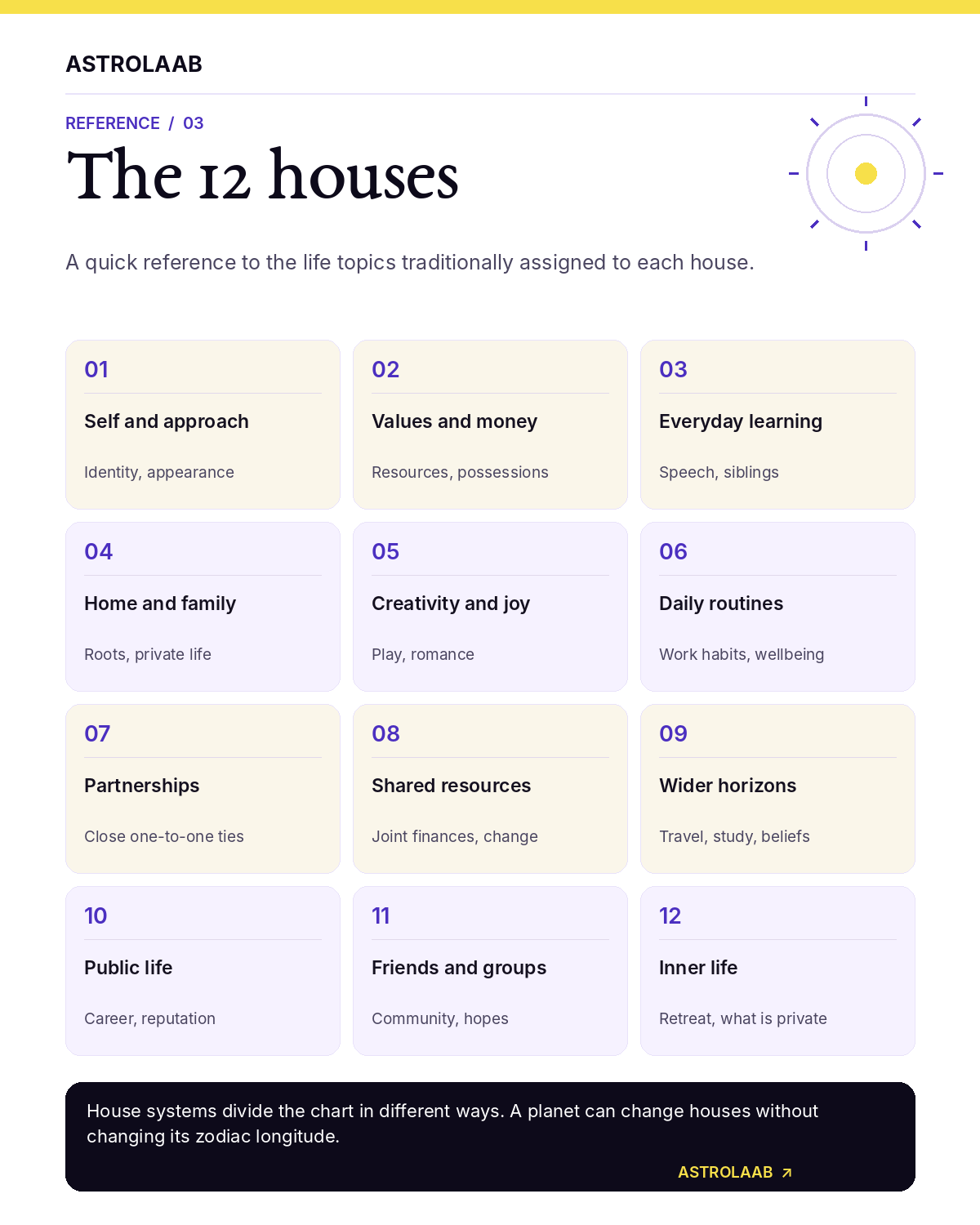
The 12 houses: meanings at a glance
- 1st: Self and beginnings.
- 2nd: Possessions and values.
- 3rd: Communication and siblings.
- 4th: Home and foundations.
- 5th: Creativity and enjoyment.
- 6th: Daily work and routines.
- 7th: Partnerships and contracts.
- 8th: Shared resources and transitions.
- 9th: Beliefs and long journeys.
- 10th: Public life and vocation.
- 11th: Friends and community.
- 12th: Privacy and retreat.
These are common teaching labels. They are starting points, not universal definitions accepted identically by every tradition. The detail in the sections below shows why a house should not be reduced to a single word.
First house — self and beginnings
The first house is traditionally associated with embodiment, presentation, initiative and the way a person begins situations. The Ascendant, or rising degree, is closely linked to this area, though its placement relative to the exact first-house cusp depends on the house system. In many astrologers’ language, it describes how someone meets the world rather than the entirety of who they are.
An Ascendant in Aries does not mean the first house is universally Aries. The sign at the Ascendant depends on the actual chart.
Second house — possessions and values
The second house is often interpreted through personal resources, material security, money, possessions and the values a person acts on. Some practitioners extend the symbolism to self-sufficiency and how resources are developed. It should not be treated as a reliable indicator of wealth or an investment forecast.
A planet in the second house is a symbolic placement, not evidence of future income. A budget and careful planning remain more useful for real financial decisions.
Third house — communication and nearby life
The third house is associated with day-to-day learning, siblings in some traditional systems, short journeys, neighbors, messages and exchange of information. Its emphasis is often on the familiar environment rather than the distant horizon.
An astrologer reading Mercury here might discuss language and curiosity, but the placement does not measure intelligence or a person’s ability to learn.
Fourth house — home and roots
The fourth house is linked with home, family background, foundations, privacy and a sense of belonging. In many Western quadrant systems, the Imum Coeli (IC) marks the bottom of the chart near this region, although its exact relation to the fourth-house cusp depends on the house method.
The chart cannot establish whether someone’s home was safe or difficult. Lived experience, personal boundaries and material circumstances always matter more than symbolism.
Fifth house — creativity and pleasure
The fifth house is traditionally connected with play, enjoyment, creative expression, romance and children in some systems. It is often read as a space for joy, experimentation and what a person makes or shares for its own sake.
Not every fifth-house placement needs to concern romance or parenthood; interpretations differ, and no placement can predict fertility or a child’s future.
Sixth house — daily work and routines
The sixth house is commonly associated with daily tasks, work routines, service, maintenance and—in historical texts—illness. Modern Western writers may focus on habits and what enables practical functioning.
It is inappropriate to use a natal chart to diagnose a disease or tell someone to change medication. For health concerns, the responsible source is qualified medical care.
Seventh house — partnership and other people
The seventh house is traditionally associated with one-to-one relationships, contracts, committed partnerships and sometimes open adversaries in older texts. Its angular point opposite the Ascendant is the Descendant (DSC).
An astrologer may discuss Venus or Saturn here when exploring partnership symbols. No planet in the seventh house can establish whether a relationship is healthy, faithful or destined to last.
Eighth house — shared resources and change
The eighth house is often linked with resources tied to other people, inheritance, taxes, debt, obligations, mortality and deep transitions in some traditions. Modern writers may emphasize emotional change and intimacy.
It is particularly important not to sensationalize this house as proof of death, trauma or catastrophe. Such predictions are unsupported and can be harmful.
Ninth house — beliefs and horizons
The ninth house is traditionally associated with long-distance travel, philosophy, higher learning, religion, meaning and broader intellectual or spiritual frameworks. Its focus is often contrasted with the third house’s familiar, immediate environment.
A strong ninth-house emphasis may be used as a prompt to consider curiosity and different perspectives, not as a guarantee of travel or educational success.
Tenth house — public life and direction
The tenth house is linked with reputation, visible responsibilities, profession, public role and achievement. The Midheaven (MC) is an important angle related to the top of the chart, but in whole-sign houses it does not always fall on the tenth-house cusp.
Career prospects depend on skills, opportunities, circumstances and choices. An astrology chart does not determine job performance or predict promotions.
Eleventh house — community and aspirations
The eleventh house is often interpreted through friends, communities, networks, collective work, long-range hopes and support from groups. It concerns social connections beyond a one-to-one partnership.
An astrologer might ask how a person participates in a group or what causes they support. That question can be useful without treating the chart as proof of friendship quality.
Twelfth house — privacy and the unseen
The twelfth house is associated in different traditions with retreat, confinement, hidden matters, solitude, unconscious processes or spiritual withdrawal. Contemporary interpretations vary widely and can be less literal than older sources.
This house is often described too dramatically online. A twelfth-house placement is not evidence that someone has a mental-health condition, is cursed or faces secret enemies.
How to find house placements in your birth chart
- Confirm your birth date, a reliable birth time and birthplace; houses depend on the local horizon.
- Choose the zodiac (tropical or sidereal) and record the selected house system.
- Find the Ascendant/ASC and, where shown, the Midheaven/MC and IC/Descendant axes.
- Look at how the calculator numbers the house sectors or lists their cusps.
- For any planet, check both its zodiac sign and house placement.
- If your birth time is unknown, label house readings uncertain rather than inventing precision.
Two calculators with the same planetary positions can show different houses because their division systems differ. For a chart-reading walkthrough, start with our birth chart beginner’s guide.
Try it with your own chart: Generate your free Western Birth Chart to explore planet-in-house placements. For a focused list of chart relationships, open the Natal Aspects tool.
What is the difference between houses and zodiac signs?
Signs and houses are easy to confuse because both sets have twelve members. The shortcut ‘Aries is the first house, Taurus is the second’ is not a rule for every individual chart. The first house can begin with any rising sign. An Aquarius Ascendant does not magically turn the zodiac sign Aquarius into Aries.
Some modern teaching charts associate sign archetypes with house topics, but that is a mnemonic rather than the mathematics of a natal chart. In a whole-sign chart, the sign containing the Ascendant becomes the first house; the next sign is the second, and so on. In other systems, house cusps can divide the signs differently.
For signs themselves, see our twelve zodiac guides. To understand why the Ascendant is crucial, see Sun, Moon and Rising explained.
Whole sign vs Placidus vs equal houses
Whole sign: The entire sign containing the Ascendant counts as the first house; each following sign forms one house. The Ascendant degree can fall within the first house rather than at its beginning.
Equal house: The first house starts at the Ascendant degree, and each house spans 30 degrees. This is different from whole sign even though both divide the wheel into equal arcs.
Placidus: A common quadrant-based system that uses a time-based division related to diurnal motion. House sizes can vary, and calculations can become difficult or undefined at extreme latitudes.
Other quadrant methods include Porphyry, Regiomontanus and Koch. A beginner need not choose a winner immediately; what matters is understanding that the house method changes some placements while the underlying moment and planetary positions remain the same.
How do Vedic bhavas compare with Western houses?
Jyotisha also uses twelve houses, usually called bhavas, with meanings that overlap with but are not identical to familiar Western teaching labels. Many Vedic charts emphasize lagna (Ascendant) and whole-sign style rashi layouts; separate bhava charts can use alternative house calculations.
North Indian and South Indian drawings use different visual arrangements. The placement of a symbol within a diamond or square needs to be read according to the chart’s layout, not as if it were a Western circular wheel. Some methods give particular weight to the Moon sign as an additional reference point.
For context, see Vedic vs Western Astrology. Avoid interpreting a Jyotisha bhava solely with a modern Western psychological keyword.
Twelve houses FAQs
Which is the most important house?
There is no scientifically established ranking. Astrological schools may emphasize angular houses, the Ascendant and different house rulers depending on the question.
Can two planets occupy the same house?
Yes. A chart can have several planets in one house or none in another. ‘Empty’ does not mean a life area is missing.
Why is my tenth house not the Midheaven?
Some house methods place the MC on a tenth-house cusp, while whole-sign houses can put it elsewhere. The chart display may still show both.
Do houses change if I move?
The natal chart is calculated for the birth location. Relocation charts are separate techniques, not a change to the original birth circumstances.
Are there 12 or 13 houses in astrology?
Standard Western and Vedic birth-chart traditions use twelve houses. Search results about a possible 13th zodiac sign concern constellations or sign discussions, not an additional house in a conventional natal chart. The twelve houses and twelve zodiac signs are different frameworks: signs describe a zodiac position, while houses depend on the chart’s time, location and house method. To find your own house placements, start with the Birth Chart Calculator.
Do all house systems give the same houses?
No. In whole-sign houses, each zodiac sign forms one complete house starting from the Ascendant’s sign; equal houses divide the circle into twelve equal parts beginning at the Ascendant degree; quadrant methods such as Placidus can produce unequal house sizes. The choice can change a planet’s reported house even if its zodiac degree stays the same.
References and editorial note
Astrodienst Astrowiki: House — basic meanings and the relationship to birthplace and time.
Astrodienst: House Systems Overview — whole sign, equal and quadrant methods.
Astrodienst: Introduction to the House System — the whole-sign starting point.
Editorial note: House divisions are mathematical conventions in astrology; interpreting them as life predictions is not scientifically established. See our editorial policy.
Leave a Reply