
Venus in Astrology: Love, Values, Art and Pleasure
A balanced guide to Venus in astrology and how astrologers interpret attraction, values, pleasure, aesthetics and relationship style.
Venus in astrology can be used as a reflective framework for examining love, attraction, values, pleasure, beauty, and relationship preferences. This article presents traditional Vedic astrology interpretations of Venus, its houses, signs, and connections with other chart factors; these interpretations are not established scientific explanations of relationship behavior or financial outcomes.
Understanding Venus in Vedic Astrology
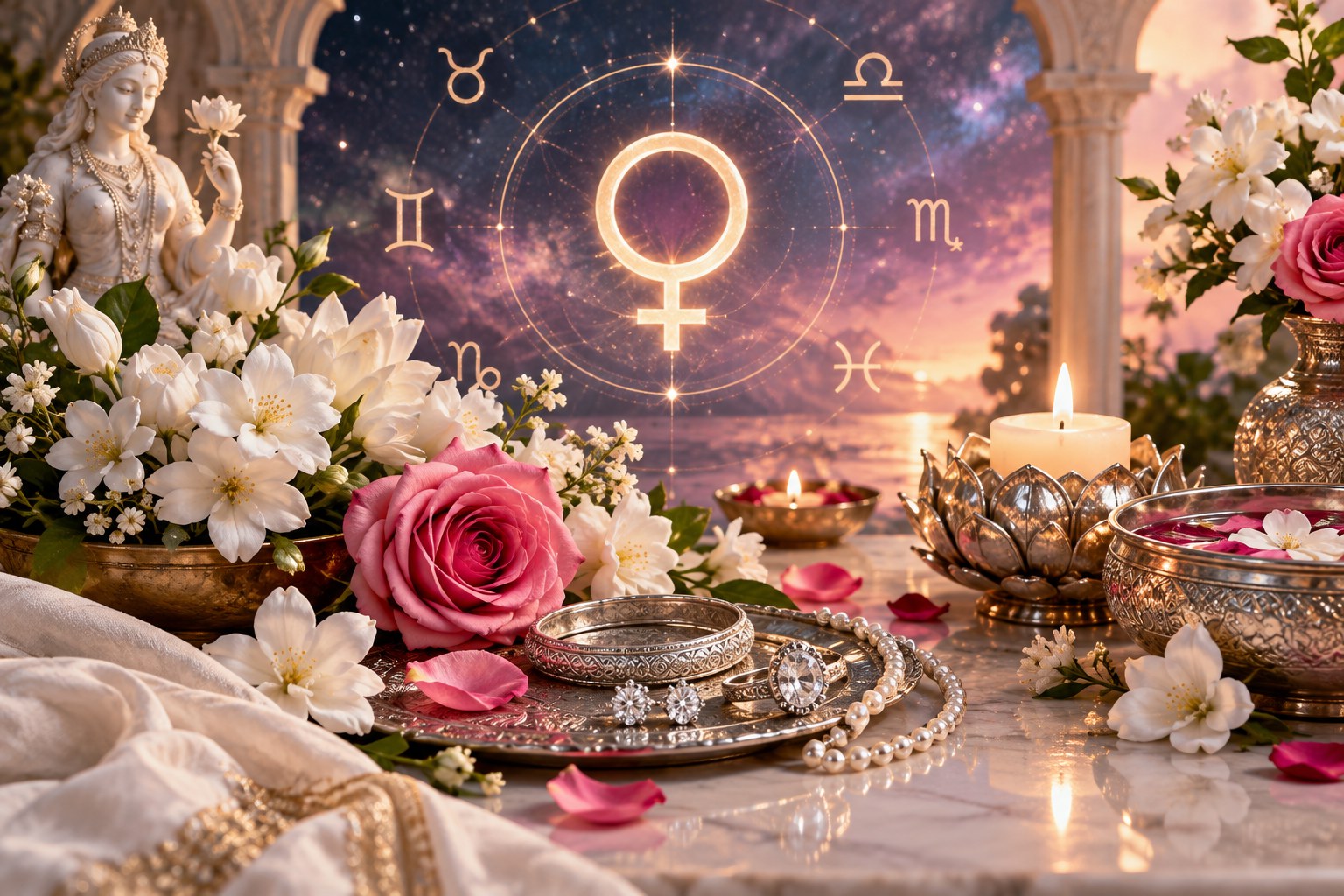
Venus, known as Shukra in Vedic astrology, is traditionally associated with attraction, affection, beauty, pleasure, agreement, comforts, art, and personal values. In a birth chart, astrologers examine Venus to understand the style through which a person may seek harmony, enjoyment, connection, and appreciation.
Venus does not independently determine who someone will love or marry. Relationship choices are also shaped by personality, experience, family, culture, circumstances, and individual decisions. A responsible chart reading therefore treats Venus as one layer of interpretation rather than a complete prediction.
In Vedic practice, Venus is also considered a natural significator for relationships, comforts, artistic expression, luxury, and material enjoyment. Its sign, house, dignity, aspects, conjunctions, and strength all change how the symbolism is interpreted.
Venus by Sign and Relationship Style
The zodiac sign containing Venus is traditionally used to describe the style through which Venusian themes are expressed. Venus in an earth sign may be interpreted through stability, practicality, consistency, and tangible value, while Venus in an air sign may emphasize conversation, ideas, social connection, and intellectual rapport.
Fire and water signs introduce different symbolic qualities. Fire may emphasize enthusiasm, directness, and passion, while water may emphasize emotional sensitivity, attachment, and intimacy. The useful question is not whether a Venus placement is simply “good” or “bad,” but what style of affection, taste, and value it traditionally represents.
Venus also changes meaning according to dignity and condition. Traditional Vedic interpretations may give additional importance to Venus in Taurus, Libra, Pisces, Virgo, and other signs according to classical rules. These classifications should be interpreted alongside the complete chart rather than used as standalone judgments.
Venus Through the Houses
House placement shifts the focus from how Venus expresses itself to where Venusian themes are emphasized. The second house can connect Venus with possessions, speech, family values, and resources, while the seventh house is strongly associated with partnership and marriage.
A fifth-house Venus may be discussed in relation to creativity, romance, pleasure, and artistic expression. A tenth-house Venus may bring attention to aesthetics, reputation, public relationships, or careers involving people and presentation. The twelfth house can shift attention toward private pleasures, retreat, foreign environments, or expenditure.
No house placement should be interpreted in isolation. The house lord, aspects, conjunctions, divisional charts, planetary dignity, and running dasha can all modify the traditional reading.
Venus and Love Patterns
Venus is one of the first factors astrologers may examine when discussing attraction and relationship preferences, but it should not be read alone. The seventh house, its lord, Jupiter, Mars, Moon, lunar nodes, and the Navamsa may all become relevant depending on the question and the Vedic tradition being used.
Venus connected with Saturn may traditionally be interpreted through themes of patience, responsibility, delay, maturity, or emotional reserve. Venus connected with Rahu can be read through intensified attraction, unconventional preferences, fascination, or difficulty seeing a relationship clearly. These are symbolic interpretations, not guaranteed descriptions of a person’s partner.
The Navamsa (D9) is especially important in many Vedic relationship readings. Astrologers may compare Venus in the birth chart with Venus and the seventh house in the Navamsa to develop a more contextual interpretation of partnership themes.
Venus, Values, Art and Pleasure
Venus is not only about romance. Traditional astrology also associates it with beauty, music, art, comfort, refinement, enjoyment, and personal values. This makes Venus useful as a reflective lens for examining what a person repeatedly chooses when time, money, or attention are limited.
A simple Venus exercise is to list three things you consistently make room for in your life and three things you find difficult to compromise on. The exercise can reveal values and preferences more clearly than a generic description of personality.
Venus can also be considered when discussing artistic interests and aesthetic preferences. However, an individual chart cannot establish that someone will become a particular type of artist or achieve a particular level of success. Skills, education, opportunity, and sustained practice remain practical factors.
Venus and Money
Because Venus is traditionally connected with comforts, possessions, enjoyment, and values, some astrologers include it when discussing spending preferences and material priorities. Venus may therefore appear in symbolic discussions about luxury, consumption, or financial comfort.
This should not be presented as financial forecasting. A Venus placement cannot establish whether an investment, purchase, business decision, or financial strategy will succeed. Use budgets, evidence, and qualified financial advice for real-world financial decisions.
Reading Venus in a Birth Chart
Chart Analysis Steps:
- Identify the zodiac sign occupied by Venus.
- Identify the house occupied by Venus.
- Check Venus’s dignity, strength, conjunctions, and major aspects.
- Examine the seventh house and its lord for relationship questions.
- For Vedic readings, compare relevant Venus factors with the Navamsa (D9).
- Review the dasha and transit context when timing is part of the question.
Practical Reflection:
- Write down the relationship qualities you genuinely value.
- Separate attraction from long-term compatibility.
- Notice where comfort or approval influences your decisions.
- Compare your stated values with your repeated choices.
The purpose of these steps is not to turn Venus into a fixed label. The chart provides an interpretive vocabulary; reflection and real-world observation provide the context needed to decide what is actually useful.
Traditional Venus Remedies
Vedic traditions may recommend remedies when Venus is considered challenged or when a person wishes to cultivate Venusian qualities such as harmony, generosity, beauty, or appreciation. These practices belong to a spiritual and cultural tradition and should not be presented as scientifically proven treatments.
Venus Strengthening:
- Traditional Friday prayers or devotional practices associated with Shukra.
- Acts of generosity involving food, clothing, art, or other Venus-associated offerings.
- Maintaining a clean, harmonious, and aesthetically pleasing personal environment.
- Practicing gratitude for relationships, creativity, comfort, and supportive connections.
Gemstones such as diamond or white sapphire are sometimes recommended in Vedic astrology for Venus, but gemstone use can have significant financial implications and is highly dependent on the full chart. It should not be treated as a guaranteed remedy or substituted for practical relationship, health, or financial decisions.
Signs of a Healthier Venus Pattern
A constructive Venus pattern can be reflected in greater clarity about values, healthier boundaries, reciprocal relationships, and enjoyment that does not depend entirely on external approval.
In relationship contexts, healthier choices may include balancing chemistry with compatibility, recognizing consistent behavior rather than relying only on initial attraction, and communicating preferences directly.
Astrology cannot establish that a planetary change caused these improvements. The useful measure is the observable change in choices, relationships, habits, and self-understanding.
Modern Tools Complementing Astrology
Relationship counseling, journaling, attachment-style education, financial planning, and creative practice can complement the reflective use of Venus. These tools address practical behavior and circumstances that astrology alone cannot measure.
For relationship questions, therapy or qualified counseling can help identify communication and attachment patterns. For financial questions, use regulated financial resources and professional advice. Astrology can remain a symbolic layer without replacing evidence-based tools.
Long-Term Understanding of Venus
Venus becomes more useful when it is treated as a language for reflection rather than a promise about what must happen. A chart can prompt questions about attraction, values, pleasure, creativity, and partnership, while lived experience tests whether those questions actually describe a person’s choices.
Over time, the most valuable Venus lesson is often discernment: knowing what you enjoy, what you value, what you will compromise on, and what you will not. In that sense, Venus can be used to explore conscious choice rather than simply predicting romance.
Traditional astrology can provide a symbolic framework for that process, but relationships, finances, creativity, and personal values remain shaped by human decisions and real-world circumstances.